


How to turn complex business thinking into brand messaging people understand, remember and care about
Most business owners can explain what they do.
Give them five minutes, a decent coffee and half a chance, and they’ll tell you about the services, the process, the people, the sector, the client stories, the journey so far and the things their competitors still haven’t quite worked out.
And to be fair, most of it matters. The problem is that it doesn’t all matter first.
This is where brand messaging often gets tangled. Not because the business is weak. Not because the founder lacks passion. Usually, it’s the opposite. The people closest to the business know too much. They understand the nuance, the moving parts, the history, the exceptions, the clever bits behind the scenes and the years of hard graft that shaped the offer into what it is now.
But the audience doesn’t have all that context.
They don’t know the backstory. They don’t know why the process works better than the old way. They don’t know why a particular service matters, or why the team’s experience should give them confidence. They’re not being difficult. They’re just arriving halfway through a conversation that, internally, has been going on for years.
So when a business tries to explain everything at once, the message doesn’t become richer. It becomes harder to hold.
And when people have to work too hard to understand what you mean, they rarely stop and ask for clarification. They quietly drift away to another website, another provider, another LinkedIn post, another conversation.
Lovely. Brutal. Very internet.
The problem isn’t explanation. It’s translation.
A lot of growing businesses don’t have a messaging problem in the way people imagine.
They can talk about what they do. Often with real energy. Sometimes with a whiteboard involved. Occasionally with so many arrows that it starts to look like a police investigation wall.
The real issue is that they’re explaining the business in language that makes perfect sense internally, but doesn’t always land externally.
There’s a big difference between saying, “We offer a full-service marketing and brand development package across strategy, content, digital and creative,” and saying, “We help growing businesses explain what they do clearly, show up consistently and attract better-fit customers.”
Both could be describing the same work. But one gives the audience a much cleaner way in.
That’s the job of good messaging. Not to make the business smaller. Not to strip out the depth or flatten the personality. And definitely not to “dumb it down”, which is a phrase that deserves to be quietly escorted from the building.
Good messaging translates.
It takes what you know deeply and turns it into something your audience can understand quickly. It keeps the meaning, but removes the maze.
Why businesses start too far into the story
This usually happens slowly.
A business starts with a fairly clear offer. Then it grows. New services are added. The team changes. A different type of client appears. The website gets amended rather than rethought. A sentence is added here, a new audience gets tucked in there, and a service page quietly becomes responsible for explaining six different things at once.
Nobody means for the message to become messy.
It just gathers layers.
Before long, the website is trying to speak to everyone, the sales team are describing the business in slightly different ways, and the founder is wondering why people still don’t quite “get” the value.
This is especially common in founder-led and expert-led businesses. The better you know your work, the harder it can be to remember what people need to hear at the beginning. You know chapter seven is important, so you start there. Your audience, meanwhile, is still looking for the front cover.
That’s not a criticism. It’s a normal consequence of being close to the work.
But it does create a commercial problem.
If your audience can’t quickly understand what you do, who it’s for and why it matters to them, they may never get far enough to appreciate the cleverer, deeper, more valuable parts of your offer.
Your audience needs a doorway before they need the full house tour
Early-stage messaging has one main job: help the right people recognise that they’re in the right place.
That sounds simple, but it takes discipline. Especially when you’re proud of the work and want to explain it properly.
The temptation is to include everything. The origin story. The full service list. The methodology. The credentials. The values. The sector knowledge. The awards. The client examples. The fact that the process is collaborative, strategic, creative, commercially focused and, yes, probably bespoke.
Some of those details will matter later.
But at the start, your audience is usually asking something much more basic: “Is this relevant to me?”
If the answer feels clear, they’ll keep reading. If it doesn’t, even the best credentials can sit there like expensive wallpaper.
This is why the first layer of your message should focus less on what you want to say about yourself and more on what your audience needs to understand first.
That shift sounds small. It isn’t.
It changes the whole shape of the conversation.
The inside-out messaging trap
Inside-out messaging starts with the business. It often sounds polished, but it can feel strangely distant because it leads with services, structure and internal language.
You’ll see phrases like “we provide”, “we specialise in”, “our approach includes” and “we deliver solutions across”. None of these phrases are wrong on their own. They have their place. The trouble starts when the whole message is built from that point of view.
Outside-in messaging starts with the world of the customer.
It begins with what they’re trying to do, what they’re struggling to explain, what they want to change, what they’re worried people don’t understand yet, or what they need to make easier for their own customers, team or stakeholders.
The difference is not just tone. It’s relevance.
A business-centred message says, “Here’s what we do.”
An audience-centred message says, “Here’s why this matters to you.”
That doesn’t mean every sentence needs to start with “you”. Please don’t do that. It gets weird very quickly, like being cornered at a networking event by someone who has read half a copywriting book and had too much coffee.
It simply means the message begins where the audience is, not where the business happens to be standing.
A better way to find the right story
When brand messaging feels muddy, the most useful thing you can do is step out of your own business for a moment and look at the world your customer is standing in.
Not just their job title. Not just their age bracket. Not just “SME business owner”, which is technically a description but emotionally about as useful as a damp napkin.
You need to understand the situation around their decision.
Where are they trying to get to? Are they growing, repositioning, preparing for investment, hiring, entering a new market, or trying to look more established than their current website suggests? What are they selling, and why is it valuable? What makes that value difficult for others to understand? Who needs to believe the message: customers, investors, internal teams, referral partners, future hires, board members, or buyers?
Then there’s the question of where the message is showing up. Website copy, LinkedIn content, proposals, pitch decks, email campaigns and sales conversations all have different jobs, but they should feel like they belong to the same business. If the website says one thing, the sales conversation says another and the social content has developed a third personality entirely, people notice. They may not be able to name the problem, but they feel the wobble.
Finally, the message needs to connect to performance. Not in a dry, spreadsheet-only way, but in a real commercial sense. What does the message need to help achieve? Better enquiries? More confident sales conversations? Stronger proposals? A clearer employer brand? More trust before a meeting? More of the right people recognising that the business is for them?
Brand messaging should not live in a pretty document that gets admired once and then buried in a folder called “Final_Final_v7”. It should help the business move.
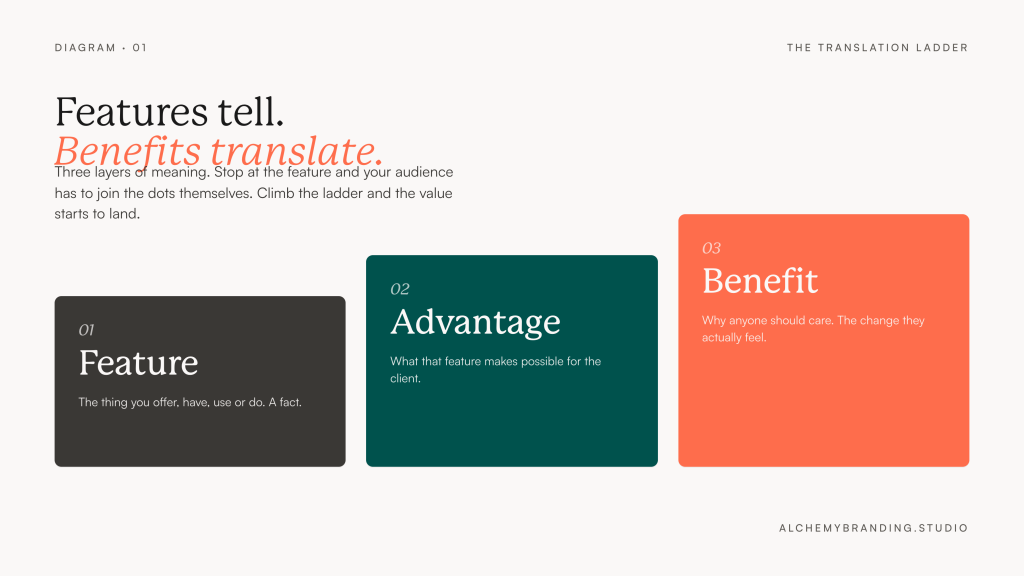
Features tell. Benefits translate.
One of the fastest ways to improve your messaging is to stop listing what your business does and start showing why it matters to the person reading.
This is where the difference between features, advantages and benefits becomes useful. Not in a corporate training room way, with a flipchart and biscuits that taste like cardboard, but in a genuinely practical way.
A feature is a fact. It’s the thing you offer, have, use or do.
An advantage explains what that feature makes possible.
A benefit explains why anyone should care.
Take a health and safety consultancy, for example. A feature might be that they offer retained competent person support. The advantage is that the client has access to qualified advice when they need it, rather than scrambling for help when something goes wrong. The benefit is that the business owner can feel more confident that risks are being managed, legal duties are being met and their team is safer at work.
That last part is where the message starts to land. Not “we provide competent person support”, but “you don’t have to carry the worry of health and safety compliance alone”. Different feeling entirely.
Or imagine an accountancy firm. The feature might be monthly management accounts. The advantage is that the client gets regular visibility of the numbers rather than waiting until year-end. The benefit is that they can make better decisions sooner, spot cashflow issues before they become ugly, and walk into board meetings without that slightly sweaty “I hope this is fine” feeling.
For a training provider, the feature might be blended learning. The advantage is that learners can combine online modules with live sessions or practical support. The benefit is that the business can train people more flexibly, reduce time away from work and still build confidence, competence and consistency across the team.
A software company might say it has a dashboard with real-time reporting. That’s the feature. The advantage is that leaders can see key information in one place without chasing updates across five systems and seventeen spreadsheets. The benefit is faster decisions, fewer surprises and less time spent asking, “Does anyone know which version is the latest one?”
And yes, the same applies to brand and content work.
SEO-led blog content is not just “regular content shaped around search behaviour”. That’s the feature. The advantage is that the website becomes more useful, visible and searchable over time. The benefit is that ideal clients can find your thinking before they’re ready to buy, so when they do need help, you already feel familiar, credible and worth speaking to.
Brand messaging is not just “a set of messaging pillars”. The advantage is that your team has clearer language to use across the website, social content, proposals, campaigns and sales conversations. The benefit is that people understand your value faster, which makes trust easier to build and buying easier to consider.
That’s the shift.
You’re not just saying, “Here’s what we do.” You’re answering the quieter question sitting underneath most buying decisions: “Why should this matter to me?”
And this is where a lot of businesses miss a trick. They stop at the feature because the feature feels obvious to them. They assume the audience will join the dots.
Sometimes they will.
Often, they won’t.
Good messaging joins the dots for them. It doesn’t over-explain. It doesn’t patronise. It just makes the value easier to see.
And yes, this takes more thought than writing a tidy service list. Annoying, isn’t it? But it’s the useful kind of annoying.
A practical messaging checklist
If you’re not sure whether your message is working hard enough, try reading your website, proposal deck or LinkedIn profile as if you’ve never met the business before.
Then ask a few uncomfortable questions.
Can someone understand what you do within the first few seconds, or do they need to piece it together from several pages? Is it obvious who you help, or are you hoping people will recognise themselves somewhere in the wording? Does the message speak to a real problem, goal or desire, or does it mainly describe your services? Are you using language your audience would naturally use, or language that mostly makes sense inside your team?
It’s also worth asking whether your sales team, leadership team and marketing team would describe the business in broadly the same way. They don’t need to sound scripted. In fact, please spare us all from that. But if everyone is telling a slightly different story, your audience is probably getting a slightly different experience every time they meet you.
And here’s the big one: does your current message reflect the business as it is now, or the business you were three years ago?
That question catches a lot of people out.
Because businesses move. Messages often lag behind.
The full story still matters
None of this means your full story should disappear.
Your history matters. Your process matters. Your values, proof, case studies, technical detail and founder journey may all help someone choose you.
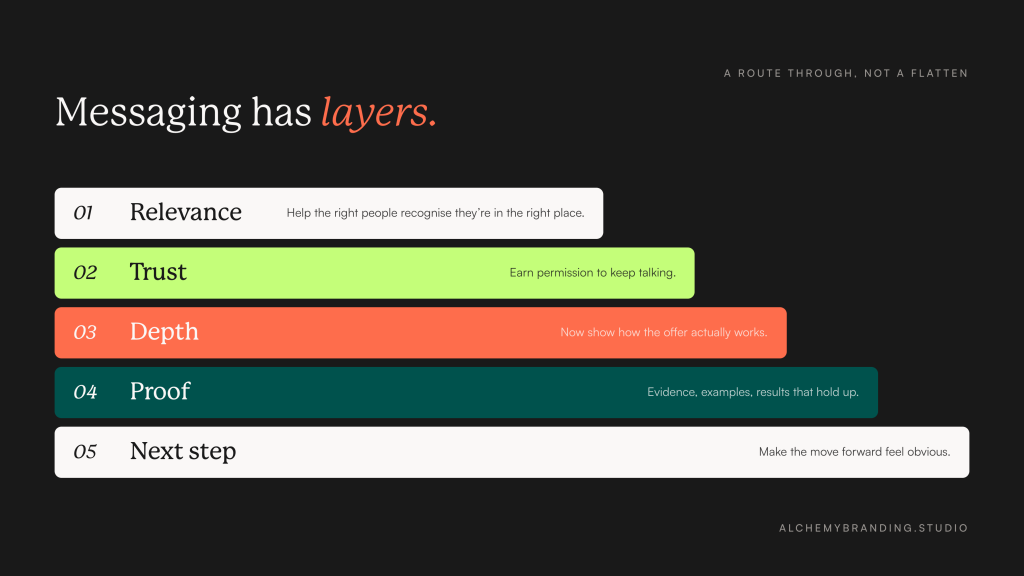
But messaging has layers.
You don’t tell someone everything at once. You guide them through it.
First, you help them recognise the relevance. Then you build trust. Then you show depth. Then you give proof. Then you make the next step feel clear.
A strong brand message doesn’t flatten the business. It creates a route through it.
That route matters because your audience is busy. They’re distracted. They have too many tabs open, too many decisions to make and, quite possibly, a child asking where their PE kit is while they’re trying to review supplier options. People need clarity quickly.
Clear doesn’t mean basic.
Clear means generous.
It means you’ve done the thinking for them.
The right story earns attention
Your audience doesn’t need the whole story straight away.
They need the right one.
The one that helps them feel understood. The one that makes your value easier to recognise. The one that turns complexity into clarity without stripping out the character of the business.
Because when people understand you faster, they trust you sooner.
And when they trust you sooner, better conversations begin.
That’s where brand messaging earns its keep. Not as a nice-to-have exercise, but as a commercial tool that helps the right people see why you matter.
If your business has grown, changed or become harder to capture in a few simple words, that’s not a failure. It’s a sign the message needs to catch up.
Need help finding the right story?
If your message feels clear to you but doesn’t seem to be landing with the people you want to reach, it may be time to look at it from the outside in.
At Alchemy, we help founders, business owners and growing teams turn complex ideas into brand messaging people can understand, remember and act on. That might mean reviewing your website, sharpening your core message, creating clearer content pillars, or building practical checklists your team can use across social posts, proposals, campaigns and sales conversations.
If you’d like support, get in touch with Alchemy and we’ll help you work out what your audience needs to hear first, what can wait until later, and how to make your message feel clearer without losing the personality, depth or ambition behind the business.
Because the whole story matters.
But the right story is what gets people to listen.


